



USCB Partners to Measure Salt Marsh Change in the Port Royal Sound
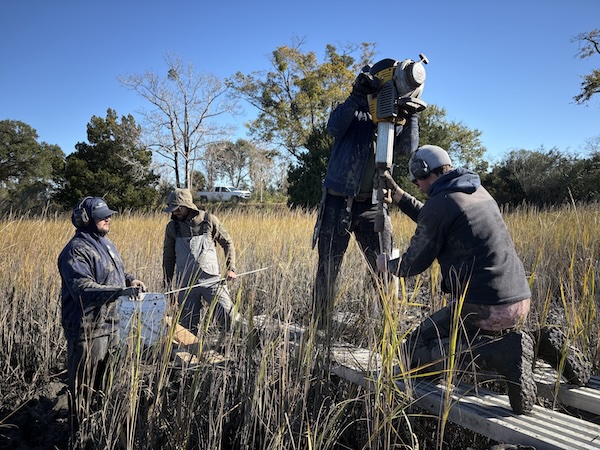 USCB's Jude Roman, Clayton Newton and Tyler Hassig work with the Port Royal Sound
Foundation's Chris Kehrer to install a research station at Knowles Landing in northern
Beaufort County. The study will reveal how salt marshes are changing over time.
USCB's Jude Roman, Clayton Newton and Tyler Hassig work with the Port Royal Sound
Foundation's Chris Kehrer to install a research station at Knowles Landing in northern
Beaufort County. The study will reveal how salt marshes are changing over time.
Knee-deep in pluff mud, racing the tide, and hauling lumber across salt marsh—this isn’t a typical day in the classroom. But for USCB marine biologist Dr. Tye Pettay, staff from the Port Royal Sound Foundation and USCB students Jude Roman and Clayton Newton, it’s exactly where learning comes alive.
Pettay and his students are partnering with the Port Royal Sound Foundation (PRSF) to play a key role in a major new research effort in the Port Royal Sound watershed, home to nearly 100,000 acres of salt marsh—about one-third of all the salt marsh habitat in South Carolina. These marshes quietly protect coastal communities by buffering storm surge, filtering pollutants, storing carbon, and supporting fisheries that contribute millions of dollars in economic value each year.
Despite their importance, one major question remains largely unanswered in Port Royal Sound: Are these marshes keeping up with sea level rise? The answer is important because unless marshes build up enough sediment to keep pace with rising seas, they"drown" and convert to open water.
To help answer this question, the PRSF and USCB’s Natural Sciences department have partnered to establish a new network of research stations throughout the watershed. PRSF was recently awarded funding through SECOORA, a NOAA-affiliated coastal observing program, to install 12 permanent Rod Surface Elevation Table (RSET) stations —filling a critical data gap along the South Carolina coast.
“We are excited about this multifaceted project!" said Chris Kehrer, Science Program Manager at Port Royal Sound Foundation. "The RSET stations provide the first data driven view of how dynamic our marshes are, as well as a platform for student-lead projects for decades to come.”
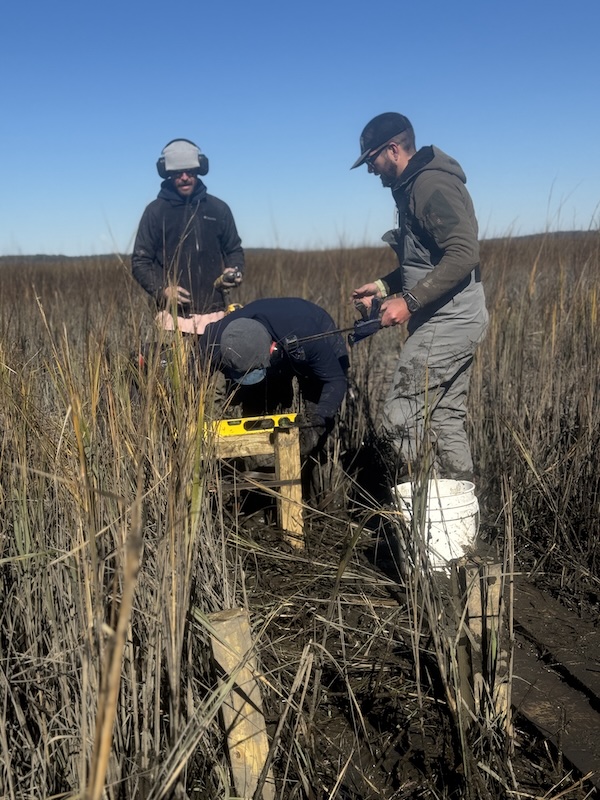
Pettay’s involvement has brought his students and USCB Natural Sciences boat captain Tyler Hassig directly into the heart of the project. Hassig, Roman, Newton and several other USCB Marine Science students have been assisting with site preparation, logistics, and fieldwork. They're gaining hands-on experience with long-term coastal monitoring at a level that undergraduates don't typically experience.
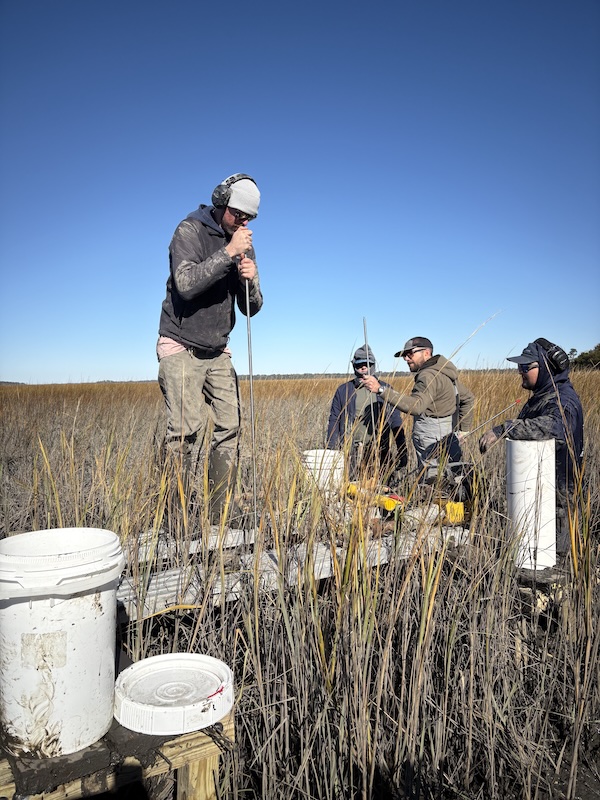
Installing a SET station is no small task. Each site requires constructing two small piers with heavy timbers and driving a stainless-steel rod more than 60 feet into marsh sediments. The work must be completed during low-tide windows. Every installation takes several hours and a lot of muscle.
“Teamwork makes the dream work,” Newton said. “This cannot be done by a single person and is still difficult with several of us but at least doable.”
The SET stations are designed to last 50 years or more, so data collected now will inform resilience research for decades to come. The scientists will start collecting data from the stations in the first quarter of this year and will continue visiting each station quarterly to take measurements.
“Although this project will not yield short term data, I feel proud to create something that will likely be a valuable tool for geologists and biologists of the future,” Roman said.
Once installed, the stations are barely visible, tucked among the marsh grasses. But the data they generate is powerful. Quarterly measurements will track tiny changes in marsh surface elevation—key indicators of whether marshes are building vertically fast enough to keep pace with sea level change.
The stations form a transect across the watershed, with locations including USCB’s Pritchards Island, Parris Island, Knowles Point, and other key sites. Data collected will be shared with state partners, conservation groups, and an international database used by researchers worldwide.
For Roman and Newton, the experience connects theory to reality.
“The SET stations will measure the rise or fall of our marshland to determine if it is eroding or building up. This will be useful for companion studies for organisms that live in the marsh and for surrounding ecosystems to see how they react to change,” Newton said.
At USCB, that’s the goal—turning coastal challenges into opportunities for learning, discovery, and long-term stewardship of the Lowcountry’s most vital ecosystems.
- USCB -
CW 1/12/2026